Can using RLT for hair growth with positive thinking and mindfulness make your hair thicker? I tried photobiomodulation hair devices and short visualization routines. This article shares what I found and what science says.
I’ll explain the basics of red light therapy for hair and what visualization means. Then, I’ll summarize studies and share a simple routine. My goal is to help you in the U.S. see if combining RLT with mindfulness can lead to healthier hair.
Key Takeaways
- RLT for hair growth uses photobiomodulation hair to stimulate follicles and scalp circulation.
- Red light therapy hair has clinical support, but outcomes vary by device and protocol.
- Visualization and mindfulness may reduce stress and improve behaviors that support regrowth.
- Combining RLT with short daily visualization could improve adherence and lower cortisol.
- I provide an evidence-based, beginner-friendly routine and clear safety notes in the full article.
RLT for Hair Growth: Can Visualizing a Fuller Scalp Actually Help?
Can mental practices like visualization and mindfulness really help with red light therapy for hair growth? I set clear boundaries for this article. It focuses on adult hair loss and stress-related shedding in healthy adults. It doesn’t cover surgical hair restoration or rare medical conditions.
Clarifying the question and scope
I explore if combining mental methods with red light therapy can improve hair follicles. I look into possible effects on hormones, blood flow, and more. I aim for realistic, modest improvements, not miracles.
Why I chose to explore both RLT and visualization together
I paired red light therapy with visualization because they both show promise. Red light devices improve scalp circulation, while visualization can reduce stress. Together, they might offer a powerful combination, even if there’s limited evidence for hair-specific visualization.
How this article links to my existing hair growth post and niche application
I previously wrote about hair growth, covering nutrition, topical treatments, and devices. This article focuses on adding a behavioral layer to RLT routines. It’s for those in the hair regrowth niche who think stress affects their hair loss.
| Focus | Included | Excluded |
|---|---|---|
| Population | Adults with androgenetic alopecia or telogen effluvium | Children, genetic syndromes, rare dermatologic disease |
| Interventions | Home RLT devices and visualization/meditation routines | Surgical grafting, complex drug regimens comparisons |
| Outcomes | Feasibility, stress markers, adherence, plausible hair metrics | Guarantees of regrowth, long-term drug efficacy trials |
| Practical aim | Offer a protocol outline for hair growth stress reduction support | Medical diagnosis or replacement for professional care |
What Is Red Light Therapy (RLT) and How It Works for Hair
Let’s break down the science in simple terms. Red light therapy uses low-level laser treatment. It uses red and near-infrared light to change cells. This process is called photobiomodulation, where light changes cell metabolism.
Basic science behind photobiomodulation
The main target is cytochrome c oxidase in mitochondria. When red or near-infrared light hits it, cells make more ATP. ATP is what fuels repair and growth.
Light can also change reactive oxygen species. It activates pathways that help cells survive and grow. The effects depend on the dose, wavelength, and power.
How RLT targets hair follicles and scalp circulation
On the scalp, RLT helps miniaturized follicles. It increases cellular energy, pushing follicle cells into the growth phase. This can lead to thicker hair over time.
RLT also reduces inflammation and boosts blood vessel growth. Better circulation means more nutrients and oxygen for follicles.
Typical devices, wavelengths, and treatment protocols
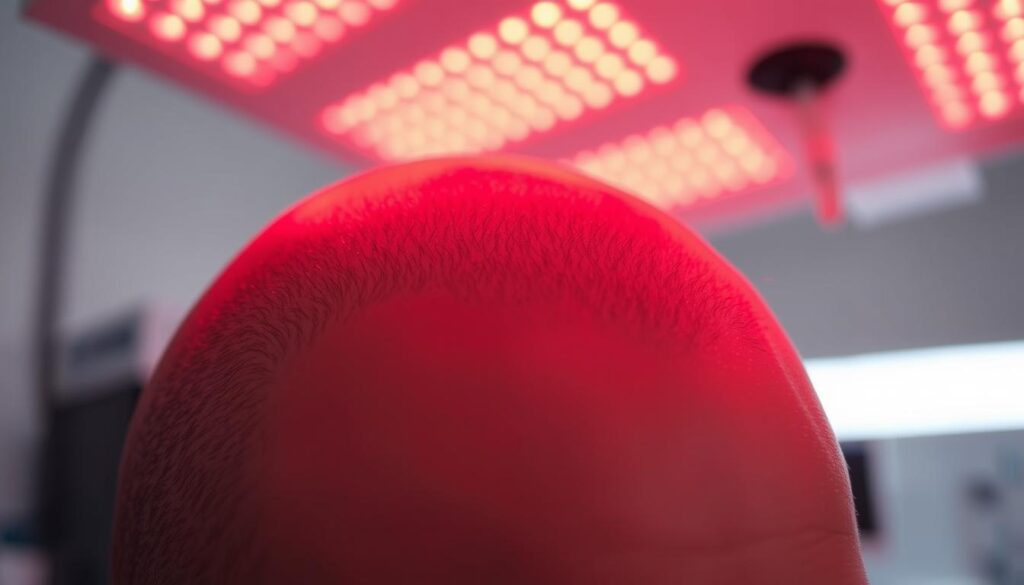
Common wavelengths are red (630nm–660nm) and near-infrared (810nm). Many devices use a mix of these, like 660nm and 810nm. This targets both surface and deeper tissues.
Devices for hair range from clinical panels to at-home helmets and combs. Brands like Capillus and HairMax are popular for clinical units. At-home options are more convenient but have lower power.
Recommended treatment is 2–5 sessions a week, lasting 10–20 minutes each. Studies show visible results after 12–24 weeks. Always follow the device’s protocol and clinical guidance for best results.
The Role of Stress in Hair Loss and Why It Matters for RLT
I see stress as a signal that can make hair follicles go into defense mode. This often leads to more hairs resting and falling out. This makes treatments like red light therapy less effective until stress is reduced.
How stress-related pathways affect follicles
Stress, whether short-term or ongoing, can cause telogen effluvium. This is when many follicles move too early into the resting phase. This results in widespread hair loss that shows up weeks to months later.
The hormone changes behind this include how cortisol and stress interact with hair follicles. High cortisol and stress can increase inflammation and lower blood flow to the scalp. This makes it harder for hair to grow.
Why reducing stress can complement RLT outcomes
RLT works by boosting mitochondria, improving blood flow, and reducing inflammation locally. But if stress keeps cortisol high and the immune system active, these benefits may be lessened.
Lowering stress helps create a better environment for hair growth. This makes photobiomodulation more effective in repairing cells and improving blood flow. In short, reducing stress can enhance the effects of RLT.
Evidence linking stress reduction to improved hair health
Studies show that when stress is managed, many people see hair regrowth over time. Interventions that lower stress have been linked to lower cortisol and inflammation levels.
Research on meditation and stress management shows better well-being and lower cortisol. These changes are linked to healthier follicle signals in lab studies. This suggests a path from reduced stress to better hair health.
What Positive Visualization and Mindfulness Are
I often start sessions by explaining simple differences between mental practices so readers know what to try. Visualization and guided imagery use intentional mental images of desired outcomes. Mindfulness meditation emphasizes nonjudgmental, present-moment awareness. I blend both approaches in short practices to suit busy schedules.
Defining visualization, guided imagery, and mindfulness meditation
Visualization is the deliberate creation of a mental scene that reflects a goal. For hair work, that means picturing thicker strands or a calm, healthy scalp. Guided imagery hair refers to scripted prompts that lead the mind through those scenes.
Mindfulness meditation focuses on breath, body sensations, or sounds without judgment. I teach mindful visualization where you hold a clear image while staying grounded in breath.
Mechanisms: autonomic nervous system, stress hormones, and behavioral changes
These practices shift the autonomic nervous system toward parasympathetic tone. This lowers sympathetic arousal and reduces cortisol spikes. Lower cortisol and fewer pro-inflammatory cytokines create an internal environment that favors repair.
I have seen the behavioral ripple effects too. Better sleep, calmer routines, and less scalp picking are common. These habits help make medical or device-based hair treatments more consistent and potentially more effective.
Common visualization techniques people use for body-focused goals
Sensory-rich imaging asks you to imagine touch, warmth, and movement. For hair, that might include feeling scalp warmth and seeing fuller hair in a mirror. Paired breathing combines slow inhales and exhales with each image shift.
Progressive muscle relaxation with positive imagery tenses and releases muscle groups while you visualize healthy follicles. Scripted guided meditations for hair-health often include tactile cues, color metaphors, and short affirmations to keep attention focused.
| Technique | What to Do | Typical Session Length | Primary Benefit |
|---|---|---|---|
| Sensory-Rich Imaging | Picture thicker strands, feel scalp warmth, imagine gentle circulation | 5–10 minutes | Enhances vividness and emotional engagement |
| Paired Breathing | Slow 4–6 second inhales with matching exhales while holding the image | 3–8 minutes | Reduces heart rate and lowers sympathetic tone |
| Progressive Relaxation + Image | Tense/release muscles from scalp to neck while visualizing repair | 8–15 minutes | Releases tension and improves body awareness |
| Scripted Guided Imagery | Follow a recorded script that directs focus to scalp health | 10–20 minutes | Provides structure and supports consistency |
| Mindful Observation | Notice hair sensations and thoughts without judgment, then gently visualize | 5–12 minutes | Builds sustained attention and complements mindfulness stress reduction |
Scientific Evidence: Visualization Effects on Physical Health
I look at studies that check if our minds can change our bodies. I focus on trials that measured healing, recovery, and physical changes. This shows how far visualization and meditation can go in improving health.
Clinical trials and studies on visualization for wound healing and recovery
Many studies used guided imagery for recovery after surgery. They found faster wound healing, less pain, and shorter hospital stays. This is because stress goes down, leading to better healing.
Meta-analyses show small benefits, but results vary. Studies on acute wounds and burn recovery are more consistent. But, results for chronic wounds are less clear.
Research on meditation, stress biomarkers, and physiological changes
Meditation studies give us clear biomarker data. They show lower cortisol, better heart rate, and reduced inflammation. These changes are linked to better sleep and less stress.
These changes help create a healing environment in the body. That’s why meditation biomarkers are important for tissue health.
Limitations of current evidence for hair-specific outcomes
There are few direct studies on visualization for hair growth. Most data comes from related fields like wound healing and stress studies. This makes it hard to apply to hair growth.
There’s a lack of well-designed trials on alopecia and hair health. Protocols vary, and long-term studies are rare. This limits our understanding of visualization’s effects on hair.
I present the findings as close as we can get to proof. This keeps expectations in check and shows where more research is needed.
How Visualization Might Interact with RLT to Support Hair Growth
I look into how guided imagery and red light therapy can help hair health together. We’ll explore how they might work, what daily habits are important, and what to expect over time.
Physiological pathways where synergy is plausible
Stress can harm hair follicles by raising cortisol and inflammation. Visualization can lower stress, which helps hair health at the scalp. This means less damage to hair roots and a calmer immune response.
With a calmer state, RLT can work better. Red light boosts cell energy and blood flow. Visualization helps improve blood flow to the scalp, bringing oxygen and nutrients for healthier follicles.
Behavioral pathways that support treatment
Simple habits are key. Combining visualization with RLT makes it easier to stick to the treatment. A consistent routine helps keep up with sessions and track progress.
Reducing stress also improves sleep and lessens scalp touching. Better sleep supports tissue repair, which RLT aims to enhance. Less scalp picking reduces damage and shedding, creating a better environment for hair growth.
Realistic expectations and timeline considerations
I set realistic goals. Studies show RLT can lead to noticeable changes in three to six months. Visualization doesn’t promise overnight results but can improve well-being and treatment adherence.
Results vary based on age, genetics, and health. A realistic timeline should consider these factors. Seeing improvements in sleep, reduced stress, and consistent use of the device can lead to positive results over time.
Practical Protocol: Combining RLT with Visualization and Meditation
I’ve created a simple plan that links red light therapy with mindful visualization. Start with a small goal, build a daily habit, and track changes in sleep, stress, and hair shedding. The goal is to make a RLT daily routine that fits into your life.
Sample daily routine
Begin with 10–20 minutes of RLT, then do 5–10 minutes of guided scalp visualization. Most home devices need one session a day. If time is tight, try a 3–5 minute micro-visualization after a quick 5–10 minute light session.
Guided visualization script (read aloud or record)
Start with three slow, deep breaths. Feel your feet on the ground and relax your shoulders. Scan your scalp, noticing any warmth, texture, or tension without judgment.
Imagine warm red light covering your scalp. See it soak into each follicle like sunlight. Picture your follicles waking up, your hair growing thicker over time.
Feel your hair shafts getting stronger. Imagine your hair growing thicker when you move your head. Listen to the sound of air through fuller hair. Say a short prayer of thanks and set an intention for care and consistency.
End with two deep breaths and a reminder to drink water and rest. Follow the device’s instructions carefully.
Timing, frequency, and duration tips
Focus on being consistent before worrying about how long you do it. Aim for a daily 10–15 minute session for 12 weeks before judging results. Match your session time to your schedule to make it a habit. Always use your RLT device as the manual says to avoid overuse.
Practice your guided scalp visualization at the same time every day. If you miss a day, do a quick meditation hair routine on the go. Keep a simple log of your sessions, sleep, stress, and hair shedding to see how they relate.
| Goal | Typical Session | Frequency | Duration |
|---|---|---|---|
| Build habit | 5–10 min RLT + 5 min visualization | Daily | 10–15 minutes |
| Busy schedule | 5 min RLT or 3 min micro-visualization | Daily or alternate days | 3–8 minutes |
| Device-restricted use | Follow manufacturer RLT timing + 5–10 min guided script | As recommended | 10–20 minutes |
| Tracking progress | Short notes on sleep, stress, shedding | Weekly review | 5–10 minutes |
This framework helps keep the practice simple. A regular RLT and visualization routine can help you stick to it and reduce stress. Adjust the timing and frequency based on your device’s instructions and how you feel.
Safety, Side Effects, and When to See a Professional
I talk about safety and limits so you can use red light therapy safely. I cover common side effects, when to slow down, and when to see a dermatologist or trichologist.
RLT safety is mostly good if you follow the device’s instructions. Most people feel only mild effects like a warm scalp or temporary redness. But, using it too close to the scalp or not following the guide can cause discomfort.
It’s important to read the manual, use the right distances, and protect your eyes when needed. This way, you can enjoy the benefits without risks.
Some situations need caution. If you have an active scalp infection, open wounds, or are taking certain medications, stop treatment and talk to a doctor. This is to avoid any unwanted side effects.
Visualization is helpful but doesn’t replace medical tests. It can’t diagnose sudden hair loss or scalp problems. Always get a proper check-up if you notice any unusual symptoms.
I recommend seeing a specialist if you have sudden or patchy hair loss, scarring, or severe symptoms. This includes scalp pain, discharge, or unexplained fatigue. Family history of aggressive alopecia also requires early action.
When deciding to refer someone, I look at the severity and duration of symptoms. If there’s no improvement after six months, it’s time to see a dermatologist or trichologist. Keeping a record of hair changes and treatments helps in these appointments.
| Area | Common Findings | Action I Recommend |
|---|---|---|
| Typical mild effects | Warmth, brief redness, slight irritation | Follow device guide, shorten session, use eye protection if advised |
| When to pause RLT | Open wounds, active infection, photosensitizing meds | Stop therapy and consult prescriber or dermatologist |
| Signs to see specialist | Rapid shedding, patchy bald spots, scalp pain, discharge | Book dermatology or trichology consult promptly |
| Monitoring timeline | No clear improvement after 6 months of combined care | Refer for diagnostic workup, consider blood tests and biopsy |
Niche Application: Using Meditation to Reduce Stress and Improve RLT Results
I focus on reducing stress because many hair problems are linked to it. Telogen effluvium often happens after stress, and chronic stress can make androgenetic alopecia worse. When stress goes down, hair growth often increases, helping RLT work better.
I suggest meditation for hair loss as a safe, effective way to tackle shedding. Pairing meditation with RLT can lower cortisol, improve sleep, and boost scalp circulation. This makes RLT more effective.
Here are some meditation styles I find helpful for hair-related stress:
- Mindfulness-Based Stress Reduction (MBSR) — structured, evidence-backed, and good for lowering stress biomarkers.
- Loving-Kindness Meditation — reduces anxiety and self-criticism that often accompany visible hair changes.
- Breath-Focused Micro-Meditations — short, practical tools to use during work breaks or before RLT sessions.
- Guided Imagery — brief scripts that include imagery of a healthy scalp and follicle resilience to reinforce behavior and calm the nervous system.
I often suggest apps like Headspace, Calm, and Insight Timer for guided scripts and timers. These services make it simple to build consistent practice without needing a therapist or long sessions.
This strategy fits into my wider hair growth framework: lifestyle optimization, evidence-based topicals or systemic therapies when indicated, and behavioral supports that boost adherence. Combining RLT with regular meditation for hair loss increases the chance that device benefits translate into visible change.
To track progress, I advise a simple plan: take baseline photos, keep a symptom journal, note meditation minutes and RLT sessions, and review every six to eight weeks. Small, consistent habits often yield clearer mindfulness hair results over time.
| Component | What I Recommend | Why It Helps |
|---|---|---|
| Meditation Style | MBSR, loving-kindness, breath micro-meditations, guided imagery | Reduces stress hormones, eases anxiety, improves sleep |
| Timing | 5–20 minutes daily; brief session before or after RLT | Sets calm baseline for RLT effectiveness and adherence |
| Tools | Headspace, Calm, Insight Timer, short self-guided scripts | Easy access to guided practices and timers for habit building |
| Tracking | Photos, symptom journal, session log | Provides objective and subjective measures to review progress |
| Expected Benefit | Supportive environment for RLT, reduced shedding episodes | Enhances local follicle response by improving systemic health |
Conclusion
I conclude that the RLT visualization conclusion is cautiously optimistic. Red light therapy is backed by strong evidence for hair growth. Visualization and meditation, on the other hand, are low-risk ways to reduce stress and improve sleep. They can also help you stick to your routine.
My advice for realistic hair growth is to follow proven RLT methods. Add short, consistent sessions of visualization or meditation to your routine. Just five to ten minutes after light therapy can be enough for many.
It’s important to track your progress with photos and notes over three to six months. This way, you can see real changes. If you notice rapid shedding, scalp inflammation, or no improvement, see a dermatologist.
I suggest trying a combined plan of RLT and meditation. Keep an eye on your results. If you’re not seeing progress, it’s time to get professional help. For more detailed advice, check out my full hair growth post. Remember to document your progress and get regular professional check-ups.